
Modern software systems are increasingly built using microservices architecture, where applications are composed of small, independent services that communicate over APIs. While microservices offer scalability, flexibility, and faster innovation, they also introduce significant operational complexity.
Traditional CI/CD pipelines designed for monolithic applications struggle to support microservices. Managing multiple repositories, frequent deployments, independent scaling, and service dependencies requires a more advanced and automated CI/CD approach.
This is where CI/CD for microservices becomes essential. A well-designed CI/CD pipeline enables teams to build, test, and deploy each microservice independently while maintaining reliability, security, and speed.
This blog explores the concepts, architecture, challenges, best practices, and tools involved in implementing CI/CD for microservices.
What is CI/CD in Microservices?
CI/CD for microservices is the practice of automating:
- Continuous Integration (CI): Building and testing individual microservices whenever code changes.
- Continuous Delivery/Deployment (CD): Automatically releasing microservices to staging or production environments.
Unlike monolithic pipelines, microservices CI/CD focuses on:
- Independent service pipelines
- Containerization
- Automated testing at multiple levels
- Orchestration platforms like Kubernetes
- Observability and rollback mechanisms
Why CI/CD is Critical for Microservices
1. Independent Deployments
Each microservice should be deployed independently without impacting others.
2. Faster Release Cycles
Teams can push updates frequently without coordinating massive releases.
3. Scalability
Pipelines scale with the number of services.
4. Reduced Risk
Smaller changes reduce blast radius and simplify rollbacks.
5. Improved Reliability
Automated testing and monitoring catch issues early.
Monolithic CI/CD vs Microservices CI/CD
Monolithic CI/CD
- Single repository
- One pipeline
- One deployment unit
- Tightly coupled components
- Slow releases
Microservices CI/CD
- Multiple repositories or mono-repo with multiple pipelines
- Independent build and deploy
- Container-based
- Service isolation
- Fast, frequent releases
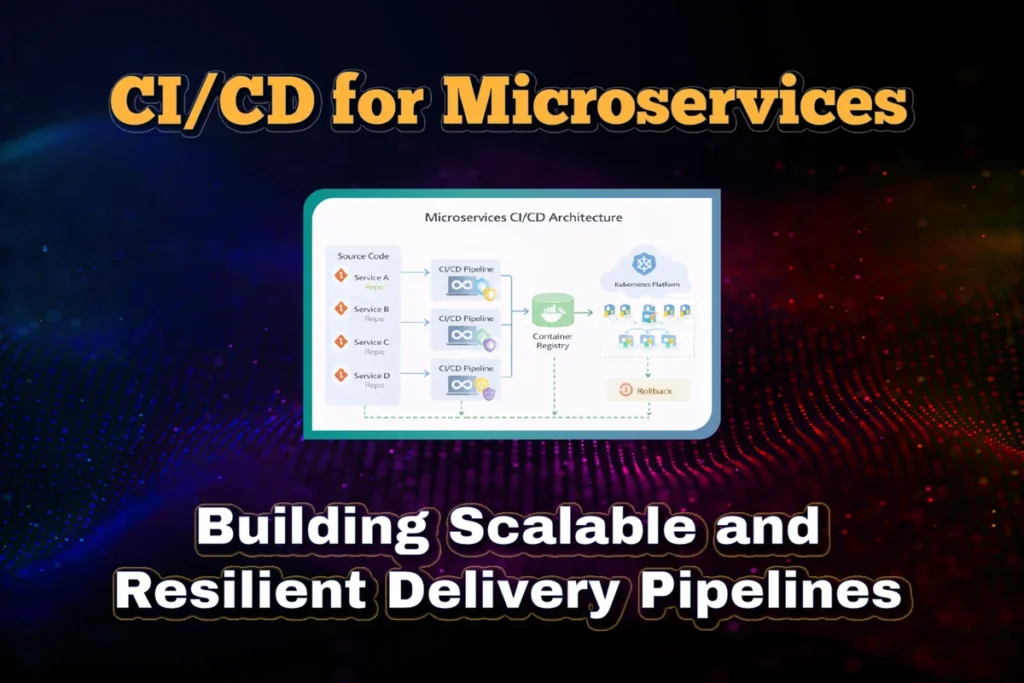
Microservices CI/CD Architecture
A typical CI/CD architecture for microservices includes:
- Source code repositories (GitHub/GitLab)
- CI pipelines per service
- Container build and image registry
- Automated tests
- Kubernetes or container platform
- Observability tools
- Rollback strategies

CI/CD Pipeline Stages for Microservices
1. Code Commit
Developers push changes to a microservice repository. Each service has:
- Its own repository OR
- A folder within a monorepo
Triggers:
- Git push
- Pull request
- Merge to the main branch
2. Build Stage
The pipeline:
- Compiles the service
- Runs unit tests
- Builds container images (Docker)
Artifacts:
- Docker image
- Versioned build
Tools:
- Maven / Gradle / npm
- Docker
- Jenkins / GitHub Actions / GitLab CI
3. Automated Testing
Testing is critical in microservices due to service dependencies.
Types of tests:
- Unit tests
- Integration tests
- Contract tests
- API tests
Tools:
- JUnit
- Postman
- Pact
- Selenium (for UI services)
4. Container Image Scanning
Security scans ensure container images are safe.
Checks include:
- OS vulnerabilities
- Dependency vulnerabilities
- License compliance
Tools:
- Trivy
- Snyk
- Aqua Security
- Clair
5. Push to Container Registry
Successfully built images are pushed to:
- Docker Hub
- Amazon ECR
- Google Artifact Registry
- Azure Container Registry
6. Deployment Stage
Deployment targets:
- Kubernetes
- Docker Swarm
- Cloud-managed platforms
Deployment strategies:
- Rolling deployment
- Blue-Green deployment
- Canary deployment
- Feature flags
Tools:
- Helm
- Argo CD
- Kubernetes manifests
7. Post-Deployment Testing
Validates that the service works in production-like environments.
Includes:
- Smoke tests
- Health checks
- API monitoring
8. Monitoring & Observability
Observability is crucial in distributed systems.
Monitors:
- Logs
- Metrics
- Traces
- Alerts
Tools:
- Prometheus
- Grafana
- ELK Stack
- Jaeger

CI/CD Patterns for Microservices
1. Pipeline per Service
Each microservice has its own CI/CD pipeline.
Benefits:
- Independent deployments
- Team autonomy
Challenges:
- Pipeline sprawl
2. Mono-Repo with Multiple Pipelines
Single repository with separate pipelines per service.
Benefits:
- Easier dependency management
- Centralised governance
3. GitOps-Based CI/CD
Deployment state is stored in Git and synced automatically.
Tools:
- Argo CD
- Flux
Benefits:
- Auditable deployments
- Easy rollback
Handling Dependencies in Microservices CI/CD
Challenges:
- Service-to-service dependencies
- Backward compatibility
Solutions:
- API versioning
- Contract testing
- Consumer-driven contracts
- Feature flags
Security in Microservices CI/CD
Security must be integrated early.
Includes:
- SAST
- Dependency scanning
- Container security
- Secrets management
- Runtime security
Tools:
- SonarQube
- Vault
- Snyk
- Trivy
CI/CD Best Practices for Microservices
- Automate everything
- Keep pipelines fast
- Use containers
- Version everything
- Apply shift-left testing
- Use GitOps for deployments
- Implement observability
- Enable easy rollback
- Isolate failures
- Secure pipelines
Common Challenges
- Pipeline complexity
- Environment drift
- Debugging distributed failures
- Testing dependencies
- Managing secrets
Real-World Use Case
An e-commerce platform with 40 microservices:
- Each service has its own CI pipeline
- Docker images built and scanned
- Deployed to Kubernetes using Helm
- Canary deployments for risky changes
- Monitoring via Prometheus and ELK
Results:
- Faster deployments
- Fewer outages
- Improved developer productivity
Future of CI/CD for Microservices
- AI-driven testing
- Automated rollbacks
- Progressive delivery
- Platform engineering
- Self-healing pipelines
Key Takeaways
- CI/CD is essential for microservices success
- Pipelines must support independent services
- Automation reduces complexity
- Security and observability are mandatory
- GitOps simplifies deployments
Frequently Asked Questions (FAQ)
1. What is CI/CD for microservices?
It is an automated approach to build, test, and deploy individual microservices independently.
2. Why is CI/CD more complex for microservices?
Because multiple services, dependencies, and deployments must be managed independently.
3. Should each microservice have its own pipeline?
Yes, for better autonomy and scalability.
4. Can microservices use a single repository?
Yes, using a mono-repo with multiple pipelines.
5. What is the best deployment strategy for microservices?
Rolling, Blue-Green, Canary, and Feature Flags are commonly used.
6. Is Kubernetes required for microservices CI/CD?
Not mandatory, but Kubernetes simplifies orchestration and scaling.
7. How do you handle failures in microservices deployment?
Using rollbacks, canary deployments, health checks, and monitoring.
8. How do you test microservices effectively?
Using unit, integration, contract, and end-to-end tests.
9. What tools are commonly used?
Jenkins, GitHub Actions, GitLab CI, Docker, Kubernetes, Argo CD, Prometheus.
10. How does GitOps help microservices CI/CD?
It provides version-controlled, automated, and auditable deployments.